

Not only do emotions give rise to thoughts but also the movement of thinking arouses a particular emotion that has rarely been acknowledged. Through such movements, we approach a physical body in which affects and emotions have been inscribed in different layers. (Through The Eyes of Descartes, Cecilia Sjöholm and Marcia Sá Cavalcante Schuback)
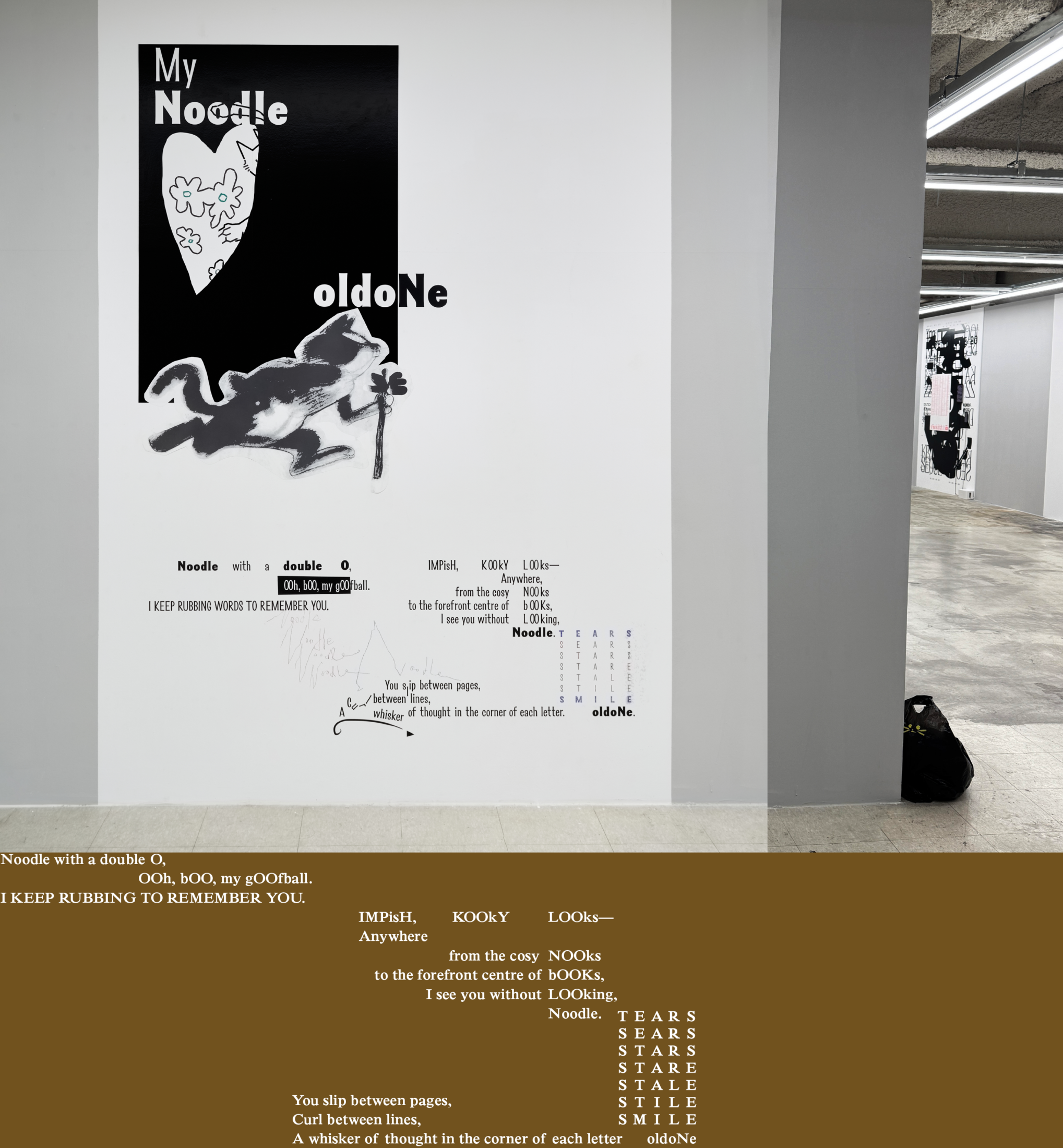
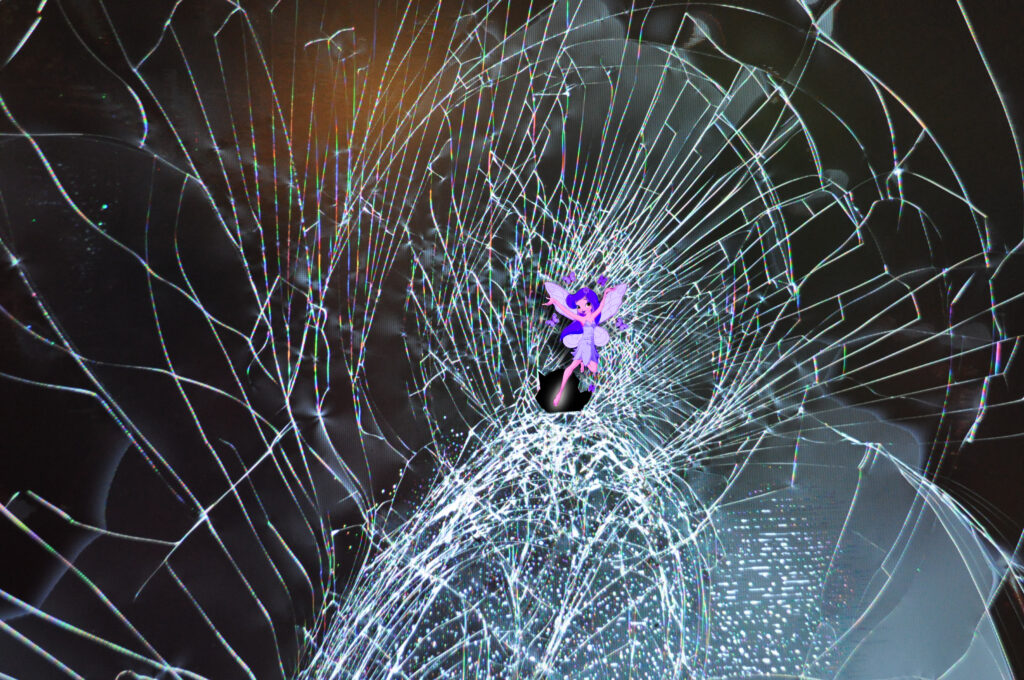

“Letters” takes the form of crosswords and rebuses, employing image representations of each illuminated letter to unveil its own unique story. Throughout its extensive history, the illuminated letter—a laboriously adorned capital letter within a textual segment—forges intricate, complementary, or sharply contrasting connections with the adjoining text. In “Letters,” an exploration of imaginative storytelling takes place, where each letter crafts stories as it shapes words, generates sounds, and culminates in imagery within a seamless cycle. The work is seen through the lens of letters as both storytellers and cumulative agents, coalescing boundless stories within their narratives.
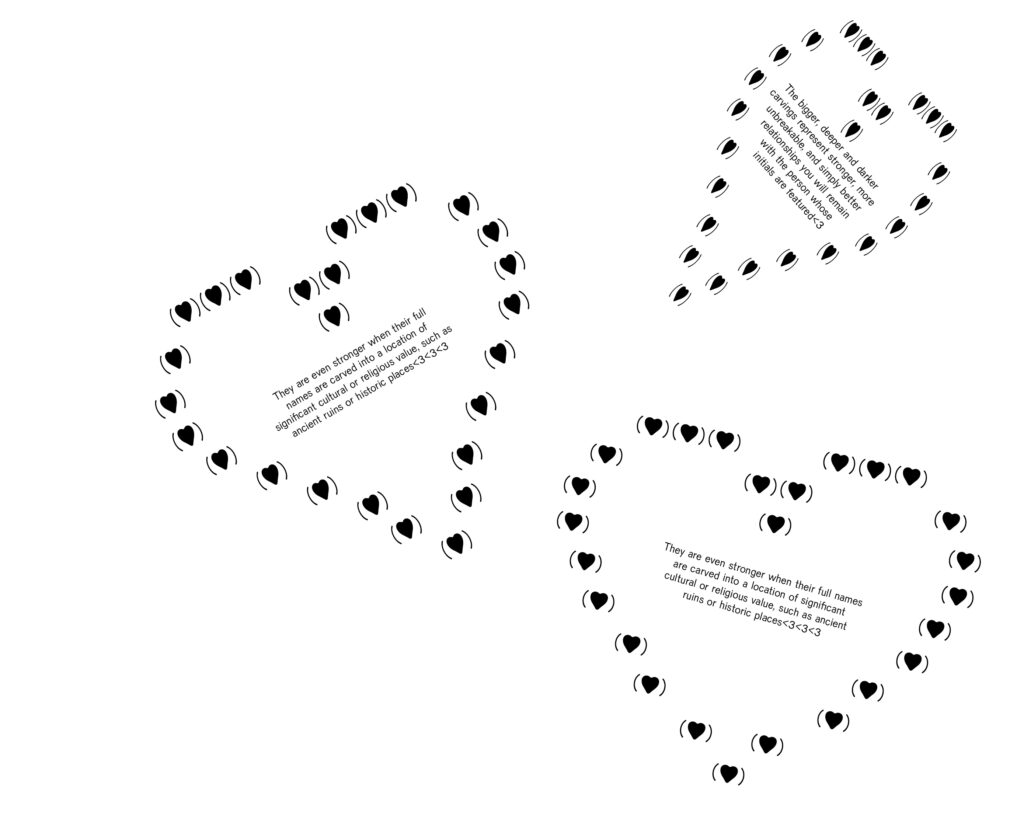


while using the toilet in a public restroom you wait for nature’s call turn your head around to find something fun to pass time the walls become an etch-a-sketch you scratch and leave your nickname LUV your gf/bf’s initials 4ever <3 you arrive at a 1,951-year-old landmark it gives you an itch to add your name in large capital letters a heart your best pal’s name in large capital letters 4ever in the most hidden corner not because your intent is to deface the landmark but to make your name more permanent <3 during the school term you secretly plan on carving something cool you don’t want to carve into the top of the desk anymore as your teacher warned you that you were vandalising school property you scrape your name your crush’s name and a huge heart around the two names 4ever on the bottom of the desk <3 your eyes spot an arrow on a rim of a bookshelf at the school library pointing at a book shortly after hesitating whether to bother opening the book yes! why not! your eyes are exposed to the very line that reads ‘i couldn’t stop thinking about you while reading this book, I love U’ <3 you get bored with scratching the same line over and over you drop the idea of inscribing your name and your idol’s name after only managing a heart later on it is found by someone else and they complete it with the name of a celebrity you never stan </3 you stumble upon an article about a study on how people who carved their names into park benches (or outdoor art installations, city sites/landmarks, and other structures intended for the enjoyment of the general population) remained together an average of three decades longer than couples who did not engrave their names into property you think it’s ridiculous that indelible carvings contribute to the longevity of one’s relationship you laugh at it you wait for your date who’s prone to running late there’s nothing else to do but etch the f-word and the name of the disgraceful leader of your country </3 your eyes scan the lines that people have carved in a public bathroom of a bar you never liked because of the music choices they make all of a sudden your eyes tear up when you spot ‘don’t forget you are worthy’ you can hear a feeble sentimental ballad you feel the warmth as you see a couple of hearts as if they are responding to the phrase until you see LOL</3

1
Depending on the angle at which the light source hits and reflects off a surface, the shadow changes its shape and size. Yet, despite these shifting reflections, the object itself remains constant, unaltered by the surrounding factors.
2
Language is fundamentally a cognitive system wherein thoughts and feelings are encoded into electrical signals in the brain by sentient beings. It is codified with variations in structure, auditory manifestations, and/or visual representation, collectively experienced by diverse and substantial communities.
3
Letterforms—the shapes of the stroke, its beginning and ending, thickness, angles and curves—contain details and expressions that evoke emotions from readers. They impose themselves upon other people and say “I am serious,” “I am friendly,” or “I am funny” in a specific tone of voice. The “tone of voice” of a typeface is a personality or characteristic that enables it to transform how the written word appears on mediums, and how it reaches a reader through their emotions and sentiments.
4
As a typographer captivated by the emotional resonance of letterforms, embodied in their external expressions, the profound influence of letterforms on the meaning of language parallels a relationship between [light – object – surface], which casts shape-shifting shadows.

It started at a conference on the speed of light and Hiroshima. The physics professor from the University of Nice explained that the dead bodies had left a lasting shadow and were built into the city walls. And suddenly I realised that I should be trying to recreate something like that in my work with images. Yes, that’s what I should be doing. (My Mother Laughs, Chantal Akerman)

Between imagery and writing, between different states of consciousness, between body and mind. Inside becomes outside, dream and reality shift places, love and hate trigger each other, and their origins are seen to be fantasmatic as they are real. (Through The Eyes of Descartes, Cecilia Sjöholm and Marcia Sá Cavalcante Schuback)

IG… what is it! All you want is to fall into sleep, but your thumb ritually taps the app to open. Going online is such an intrinsically solitary act and yet, ironically, it involves a social engagement at large. Can it work as a lullaby? Am I already dream ing? Or do I need a reality check in my pre-sleep state? Actually, it kicks me out of sleep mode. Bountiful posts and content personalised according to my growing interests, age, gender, and location might not sound so bad until you realise that you need to flush out all the Kardashians first. I am in a bubble. We all do the same things, like the same things, turn our backs on the same things. We adver tise our day, promote what we do, show off what we own. Are we humans or advertisements?
It’s a doughnut! I recall being shocked when I came across an article ten years ago talking about human topology. Basically, the human body is a lump with a hole running all the way through the middle, like a doughnut. This means that the inside of your gastrointestinal tract is outside your body. Again, any thing inside the gut is outside the body. Undigested food has never been inside the body. Your colonic bacteria live outside your body. How uncannily convoluted!
Since then, none of these formulae—“inside-outside”, “yes-no” or “right-wrong”—have worked for me. I believe that there is always an interrelated connection between these two opposing sides.
Nothing! Nothing shows me its honest self! Even mirrors give me illusional reflections. Why does it make me slimmer? A completely flat mirror should show an image of exactly the same shape and size as the actual object. So why do a lot of mirrors offer something a little way from the truth? IG’s handful of face filters are warping the way we see our faces, as well. The huge and prevalent trend of us obsessively augmenting our realities is visual proof that we are collectively in denial. I know I sound quite dramatic. These are the thoughts running through my mind while fighting insomnia.
Finally, I am sending you a description of “Real-Time Realist No.2” and my contribution to it: Published by J-LTF Press, “Real-Time Realist” is an experimental journal on the wide range of human affect (emotions) through typography, art, and contemporary writing, based on psychologist Robert Plutchik’s Wheel of Emotions . This issue—with guest editor Lieven Lahaye—explores Ecstasy, Joy, Serenity, and Love, The Yellow Wheel , with contributions from the invited artists distilling the aforesaid emotions.
“Real-Time Realist” is a container for experiments with typographic research and the intimate relations between writing, typography, and visual art. It is as a unique type specimen, not only showcasing typefaces produced by Jung-Lee Type Foundry (J-LTF), but also exploring the role of typography in linguistic materials. J-LTF manifests that type faces reach readers through their own emotions and sentiments. In that sense, each typeface acknowledges the role of itself as well as the other typefaces and how they interact with texts. My typographic research for this issue is from a feminist perspective and traces back to the printing press period in the 18th century: wood cut letters, female engraving labourers working freelance out of their homes, the emotions that were locked in let ters on the surfaces of woodblocks, and an analogy between handwriting and engraving letters, which ultimately resulted in a typeface now known as Birch. Maybe the third issue of “Real-Time Realist” could be about either the Red (anger) or Pink (disgust) or Purple (sadness) sector—darker emotions than in the previous issues. Which doughnut colour would you choose?


JL Limpet Intertidal, a compatible italicised pair to JL Limpet Granite, shares a tint of handwriting-like feature—not only appearing to be condensed for textural support to the regular style but also serving as a standalone typeface. Inspired by Cross-writing* as a practice of writing sideways on top of the first side of text, various directional axes seamlessly coexist. Dissonance finds HARMONY.

